Why the Future of Hospitality Technology Is Still Human
Hotels are investing in more technology to simplify operations, improve decision-making and deliver better guest experiences. Yet as hospitality ecosystems become more complex, technology can also create additional pressure for the people expected to use it.
The real value of innovation lies in making that complexity easier to manage and giving hotel teams more time to focus on guests. Even as AI takes on a greater role, empathy, judgement and human connection remain central to hospitality.
To explore that balance, we spoke with Bianca Rose, VP Marketplace & Integrations at Planet, a global hospitality technology provider spanning property management, payments and connected digital services. Our conversation focused on the practical value of AI, the importance of trusted integration partnerships and why the future of hospitality technology must remain centered on people.
Technology That Makes Hospitality Simpler
Hotel employees increasingly work across a complex environment of property management systems, payment platforms, revenue management tools, guest applications and operational solutions.
When these systems work together effectively, technology can simplify everyday tasks and help teams respond more quickly. When they do not, employees can spend valuable time managing technology rather than looking after guests.
For Bianca, this is where AI can deliver its most practical value.
“One of the biggest opportunities I see is how AI can help hospitality by giving employees the time they need to focus on guests and making guests happy, rather than having to worry too much about technology,” she explains.
AI should not introduce another layer of complexity. It should help hotel teams access information, find solutions and complete tasks more easily.
“It can provide an easy way to ask questions, find solutions and focus on the guest.”
The goal is not simply to introduce more sophisticated tools. It is to make technology easier to use and allow hotel employees to concentrate on the people in front of them.
The Importance of Trusted Integration Partners
Delivering that simplicity depends on what happens behind the scenes. AI and automation rely on accurate, timely information moving securely between systems. As hotel technology environments grow, integrations need to remain reliable while adapting to changing platforms, operational requirements and guest expectations.
Planet and Sirma have a long-standing partnership covering integration work across Planet’s protel on-premise environment, as well as support for certification processes involving other hospitality technology vendors.
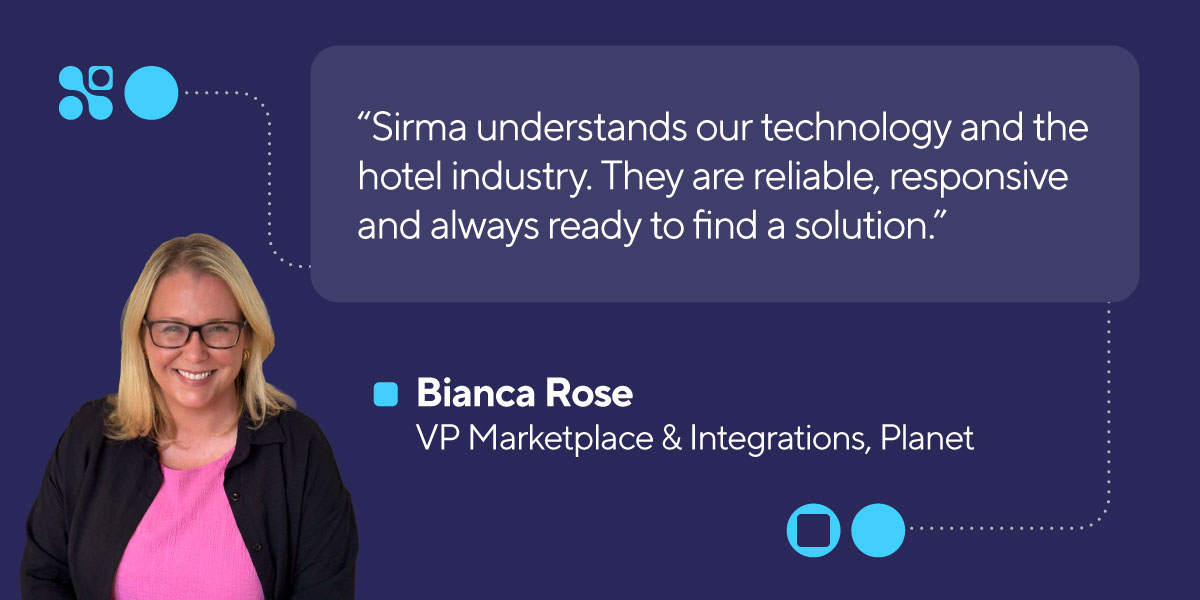
“We have had a long-term relationship with Sirma over many years, and we have always had a very good relationship with the team,” says Bianca. “They are reliable, and if challenges appear, it is easy to reach out and find a solution. We have a strong partnership.”
For Bianca, the effectiveness of the relationship comes from combining technical understanding with open and dependable communication.
“Operationally, it is about openness and trust, and knowing there is someone you can reach out to when needed. From a technology perspective, it is about working with someone who understands our scope and the hotel industry we mainly work with.”
These qualities will become increasingly important as hospitality technology ecosystems expand and AI depends on secure, reliable data moving across multiple systems.
Using AI Wisely
While Bianca expects AI to have a growing impact on hospitality, she believes hotels need to be thoughtful about how they use it and which partners they work with.
“It is very important that hotels use AI wisely and think carefully about which integration partners they work with and who they are open with,” she says.
For Planet, this means working with trusted, best-in-class partners and ensuring that data is treated confidentially.
Hotels and technology providers must consider not only what an AI solution can do, but also how it connects to existing systems, how information is handled and who has access to it.
AI cannot operate effectively in isolation. Its value depends on the wider technology environment, the quality of the integrations behind it and the trust between the organizations involved.
Supporting People, Not Replacing Them
Although AI can improve efficiency and make technology easier to use, Bianca is clear about its limitations. Hospitality remains an industry built around people. Guests remember how they were welcomed, how their needs were understood and how hotel employees made them feel.
“AI cannot solve everything,” she says. “The need for care and for understanding people is something AI could never replace.”
The role of technology should therefore be to support hotel employees, not attempt to remove them from the experience.
“AI will always help hoteliers, but it will not replace the heart of hospitality.”
That distinction is central to Bianca’s view of the industry’s future. The most valuable technology will be the technology that removes friction, helps employees find answers and gives them more time to create meaningful experiences for guests. The long-standing relationship between Planet and Sirma reflects the same focus on reliability, openness and human collaboration.
Asked to describe the partnership in one sentence, Bianca’s answer was simple:
“It is a true partnership, a partnership between equals.”
As AI takes on a greater role in hotel operations, technology will continue to change how hospitality is delivered. But its success will ultimately depend on whether it helps the industry remain what it has always been: centered on people.
About Connected Conversations Connected Conversations is a Sirma interview series spotlighting leaders who are redefining Travel & Hospitality through data, intelligence and meaningful collaboration. Because in the end, it is not about systems talking to each other. It is about people connecting ideas and turning complexity into clarity.