Sirma Strengthens Its Leadership Across Core IT Categories
The Top 100 ICT x Digitalk 101 is a well-established annual ranking widely recognized as one of the longest-running and most closely observed assessments of ICT companies in Bulgaria. This ranking* showcases the top 100 technology companies based on their projected revenue for 2025. It also features sub-rankings by market segment and analyses of industry-specific topics such as mergers, projects, technologies and salaries. Serving as a performance benchmark for the country’s technology sector, it is highly anticipated by industry stakeholders. Founders and investors often ask the same question: Who has moved up in the rankings, and how much? Sirma is proud to announce that we have maintained our position among the leaders and made significant progress.
Across more than a dozen categories from overall revenue and export performance to systems integration, hardware, software development and IT consulting, Sirma climbed. Not in one isolated metric, but broadly, consistently, and in ways that trace a clear storyline: a company that spent three decades building AI expertise is now turning that expertise into an integrated platform business, and the market is starting to notice.
The headline number: back into the Top 25
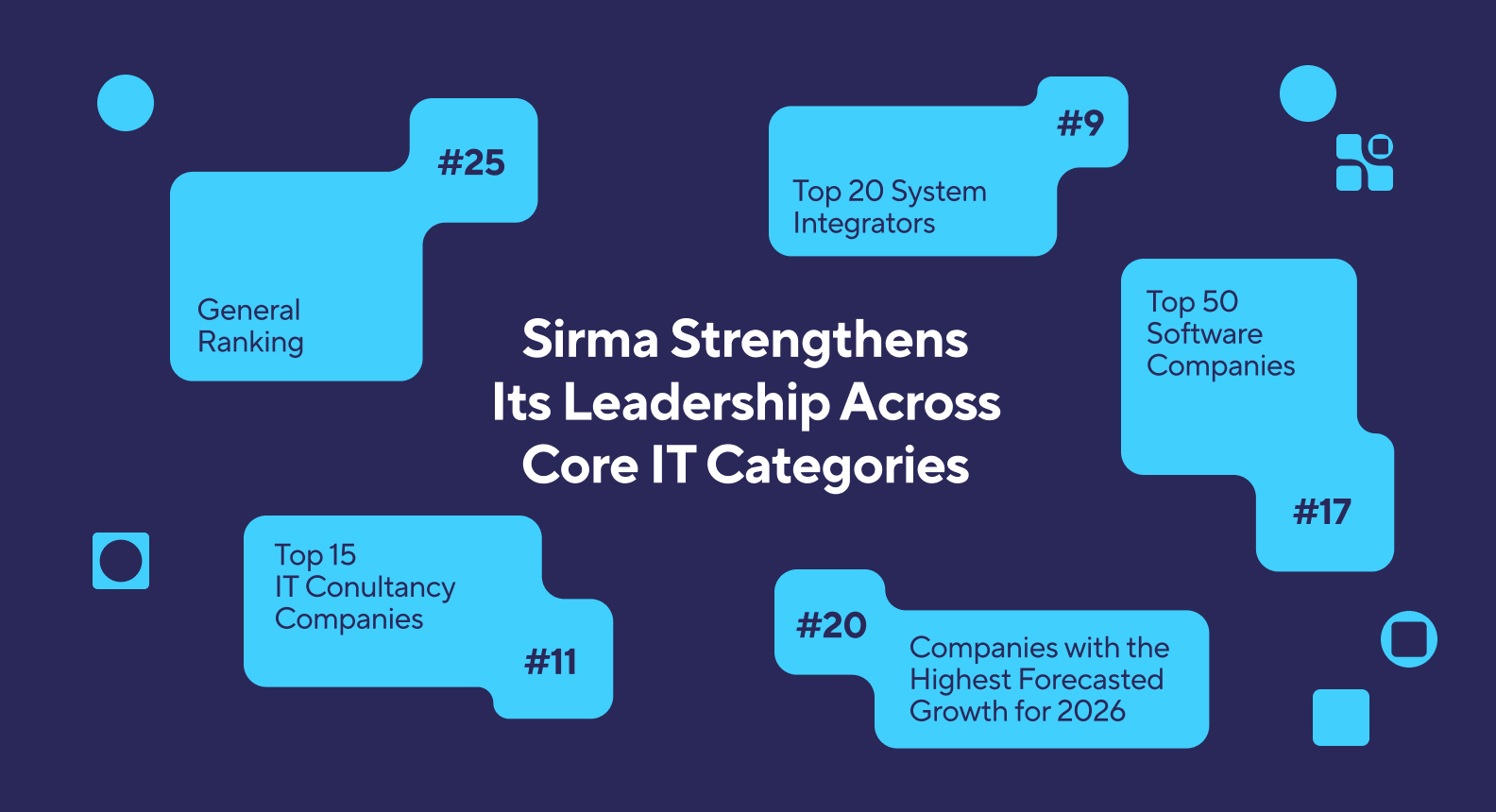
In the main Top 100 table, the ranking of Bulgaria’s largest ICT companies by revenue, Sirma moved up to 25th place, two spots better than the year before. Notably, among the top 25 companies, only three are Bulgarian; the remainder are global ICT players operating within Bulgaria. Behind that single position is a company that grew revenue from €51.1 million to €66.9 million, a jump of nearly 31% in a single year, while net profit reached €2.1 million and the team grew from 714 to 826 people.
It’s the kind of growth that doesn’t happen by accident. It shows up again and again throughout the ranking’s more specialized tables, each one measuring a different slice of the business, and together, they tell a story of a company expanding on multiple fronts at once rather than betting everything on a single product or market.
Growth that outpaces the market
Two of the report’s most-watched tables single out companies by how fast, and how sustainably, they are growing. Sirma appears in both.
Among the Top 50 fastest-growing companies in Bulgarian ICT (measured by year-over-year revenue growth), Sirma placed 24th, with that same 30.8% jump in revenue. And among the Top 50 most dynamic companies, a tougher test, based on compound growth over three years rather than a single strong year, Sirma ranked 20th, with a 2023–2025 growth rate of nearly 27%. Consistency over a hot streak: exactly the kind of trend investors and clients want to see.
The report’s forward-looking table lists companies with the highest projected revenue growth for 2026. It placed Sirma in 20th position, with an expected increase in revenue to €80 million. This aligns with Sirma’s announced strategy of turning AI expertise into a repeatable, scalable platform, which it has been working towards for the past two years.
Building the physical backbone: systems integration and hardware
Long before “AI platform” became part of Sirma’s vocabulary, the company was known for something more hands-on: connecting systems, deploying infrastructure, and making complex technology work reliably inside real organizations. That side of the business had a standout year.
In the ranking of Bulgaria’s Top 20 systems integrators, Sirma rose to 9th place, up from 10th, with integration revenue climbing from €14.6 million to €21.4 million, which is a 46.5% increase. Within that broader category, Sirma placed 4th among Top 15 hardware systems integrators, with revenue up nearly 49% to €18.7 million, and entered the Top 10 communication systems integrators table for the first time, in 6th place, with €2.7 million in revenue from a standing start.
The hardware side of the business told a similar story. Sirma placed** 9th among the Top 25 hardware companies**, with revenue up 57.9% to €29.7 million, and held 2nd place among the Top 15 PC equipment providers, growing 29.4% to €8.1 million.
Behind these numbers sits a busy year of real projects: network equipment integration for one of Bulgaria’s leading telecom operators, hardware delivery for the National Health Insurance Fund, systems integration for a mid-sized Albanian bank, and specialized cybersecurity deployments across data centers in four countries for a large fintech client. It’s the unglamorous, essential work that keeps critical infrastructure running, and it’s growing just as fast as the AI headlines suggest it should.
The software engine
If systems integration is Sirma’s foundation, software is increasingly its growth engine and here, the ranking captures a company mid-transition, investing heavily in a platform that’s only beginning to show up in the numbers.
Sirma placed 17th among the Top 50 software companies, with software revenue up 18.7% to €33.8 million, and 16th among the Top 40 software developers, up nearly 25% to €32.2 million. In the narrower category of companies selling packaged software licenses, Sirma ranked 6th, up from 8th, with license revenue growing 6.1% to €1.6 million.
These figures sit alongside a bigger story that the report shared: the successful launch of Sirma.AI Enterprise, the company’s no-code/low-code platform for building AI agents, retrieval-augmented generation architectures, and multi-LLM integrations on top of models from providers including OpenAI, Google and Anthropic. Designed for full on-premise deployment when needed, it’s built specifically for regulated sectors such as banking, healthcare, the public sector, where control over data and models isn’t optional.
That focus on data sovereignty became concrete in June, when Sirma announced a strategic partnership with STACKIT, the cloud and colocation arm of Schwarz Digits (part of the Schwarz Group, one of Europe’s largest retail and technology groups). The alliance makes Sirma.AI Enterprise available through STACKIT’s certified European cloud infrastructure, with data centers operating exclusively in Germany and Austria — giving European organizations a genuinely sovereign path to enterprise AI, without their data ever leaving EU jurisdiction. As CEO Tsvetan Alexiev put it in the ranking’s feature coverage, it’s a way to combine the company’s decades of AI experience with dependable European cloud infrastructure, turning it into a strategic partner for organizations that need innovation and trust in equal measure.
Consulting, telecom services, and quieter corners of growth
Not every line in the ranking is a headline number, but each adds texture to the picture. Sirma placed 11th among the Top 15 IT consulting companies, with consulting revenue up 17.3% to €726,000. In the Top 10 telecom services providers table, the company ranked 10th but posted the fastest growth of anyone on the list by far, with revenue nearly doubling from €944,000 to €1.8 million, an 87% jump, with a three-year compound growth rate near 45%. It’s a small line item next to the company’s overall revenue, but it’s exactly the kind of pocket of acceleration that tends to become a bigger story a year or two later.
Looking outward: exports and international expansion
A clear indication of Sirma’s direction can be seen in the Top 50 ICT Exporters table, where the company rose from 24th to 18th place. Their export revenue increased by 58.2%, reaching €36.1 million. Exports now comprise over half of the company’s total business, reflecting a significant shift that aligns with Sirma’s ambitions for global expansion.
The growth in exports is not just a concept; it has tangible implications. In 2025, Sirma established a new subsidiary, Sirma FZE, in Dubai and acquired a 55% majority stake in Sirma Sha Albania. These actions solidified Sirma’s position as a regional leader in the Balkans while expanding its reach into the Gulf region. In 2026, Sirma’s corporate strategy focused on growth and global expansion and reached two significant milestones. The partnership with STACKIT in Germany, along with the company’s simultaneous dual listing on the Bulgarian and Frankfurt Stock Exchanges, indicates that Sirma is intentionally building international infrastructure rather than simply pursuing export revenue on a project-by-project basis.
What the numbers add up to
Rankings like this one are, by their nature, a snapshot - a single year’s data, measured against a single previous year. But read across fourteen different tables, a snapshot starts to look like a pattern. Sirma didn’t have one good quarter in one segment; it grew in systems integration and in software, in hardware and in exports, in the categories that reward a single strong year and in the ones that reward three years of sustained discipline.
That’s consistent with what the company has been saying about its own strategy: that the next decade of leadership in enterprise technology won’t be won by companies selling individual tools, but by those building integrated platforms - architecture, not just applications. Sirma.AI Enterprise is the clearest expression of that bet, and the STACKIT partnership, the Dubai and Albania expansion, and the Frankfurt listing are the infrastructure being built around it.
The Digitalk 101 ranking shows, in cold, independently compiled numbers, that a company founded in 1992 to explore artificial intelligence, long before the term meant anything to most people, is still finding new gears to shift into, more than three decades later.
(*) The Digitalk 101 ranking is compiled on the basis of information provided by the companies, data from public sources and regulatory bodies, as well as the financial statements published in the Commercial Register. It includes non-financial companies registered in Bulgaria whose main activity is in the field of information and communication technologies.
Find more information here