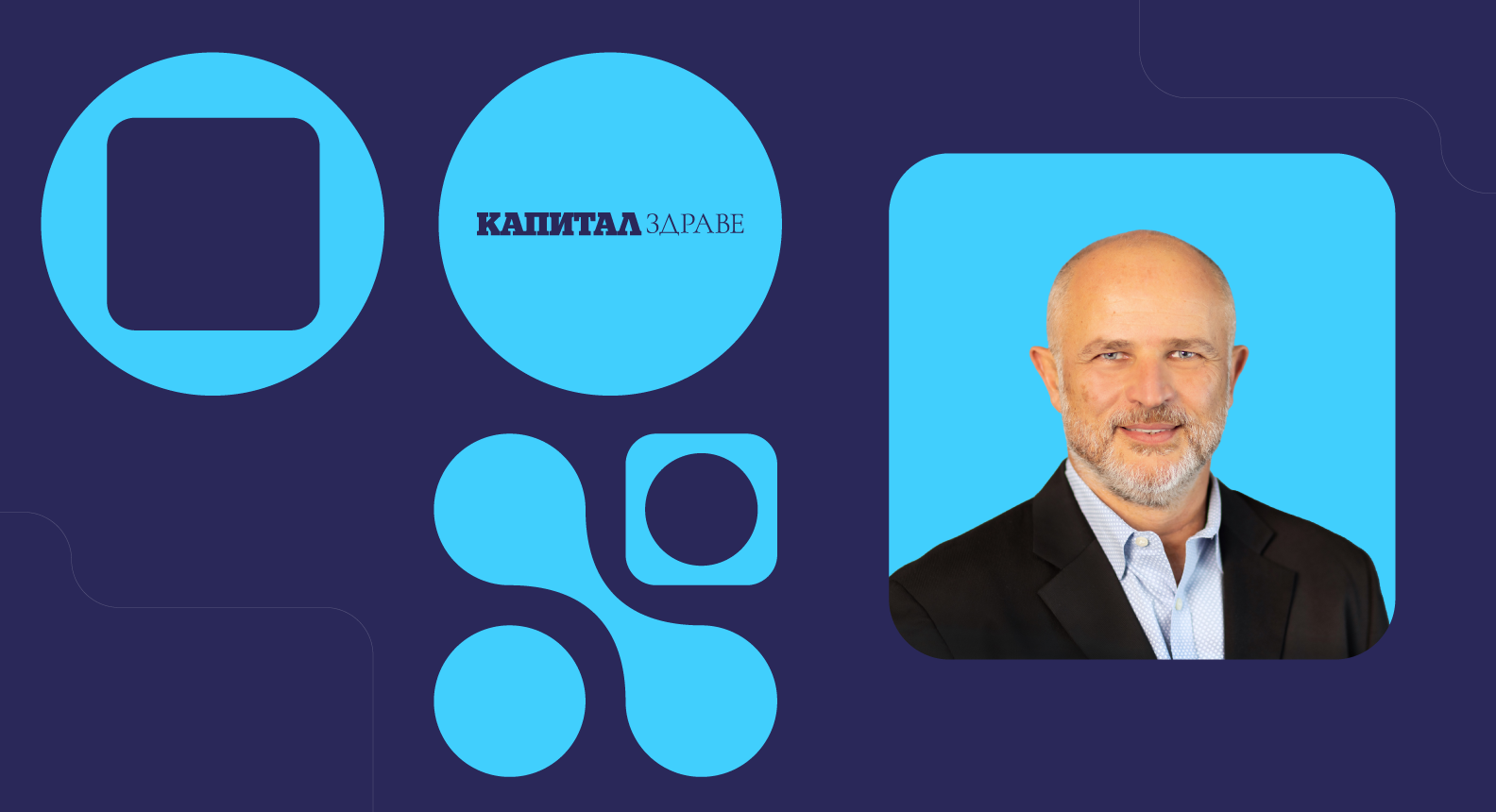
Dejan Nenov, Senior Vice President of Healthcare at Sirma Group, was featured in an interview for a special edition of Kapital Zdrave. He shared his vision for the future of healthcare services and discussed the potential value of AI agents in assisting and improving the efficiency of healthcare delivery.
What happens when a patient’s first clinical interaction is not with a doctor but with an artificial intelligence agent?
For many people, the question still sounds futuristic. In reality, it is becoming one of the most practical questions in healthcare delivery. Not because AI should replace clinicians, but because the current system too often uses the scarcest resource in medicine - qualified clinician time for work that is only partly clinical: collecting histories, reconciling documents, navigating forms and turning patient words into digital data.
Bulgaria is an uncomfortable case study of healthcare costs out of control. Between 2005 and 2012, total health spending grew at 13.5% per year, outpacing GDP growth. Per-capita health expenditure then rose 83% between 2009 and 2019, compared with 28% across the EU. In 2023, Bulgaria still spent only about half the EU average per person on health, while out-of-pocket spending remained the highest in the Union. Citizens feel the pressure of costs, clinicians feel the pressure of workload, and the system still lacks capacity where it matters most.
The answer cannot simply be “spend more.” Bulgaria, like many European systems, needs to spend differently. It needs productivity gains inside the clinical workflow. The next frontier is a redesigned front end of care, where the patient’s story is captured before the consultation, the physician receives a concise clinical summary, and the visit begins closer to providing care and treatment than data entry.

This is where agentic AI matters. Traditional healthcare software has been passive: it stores information, waits for clicks, and moves work from paper to screen without reducing the work itself. Agentic AI is different. Within defined clinical boundaries, our systems gather information, ask follow-up questions, triage urgency, orchestrate next steps, prepare documentation and support the making of better decisions in real time. The aim is not machine autonomy. The aim is to reduce the providers’ cognitive load and improve consistency.
The first visible use case is patient intake. Before a consultation, an AI agent interviews the patient and collects information about problems, complaints, symptoms, family medical history, medications, allergies, surgeries, and relevant risk factors. It translates the patient’s words into structured clinical information, flags important symptoms for review, and prepares summaries that the doctor can verify, edit, or reject. For the patient, this means a more informed and personal encounter. For the doctor, it means less time assembling the basics and more time spent on diagnosis, explanation and treatment.
One can already see the outlines of this model in platforms being built around Sirma.AI and Medrec:M Clinic. AI is not a decorative chatbot on top of existing systems. It is an enterprise-grade agent workflow that sits alongside a clinical software layer that connects patient records, telehealth, documents, scheduling, consultations and physician workflows. The AI capability is not a separate disconnected tool. It becomes an embedded service layer in the delivery of care.
Healthcare has had many “digital transformations” that did little more than digitize bureaucracy. We must always ask: does technology return time to the clinician, clarity to the patient and ultimately better health outcomes? If it does not, it is probably not a transformation. It is another screen with more buttons to click and more forms to fill out.
Used well, AI can turn a consultation with a doctor from a hunt for facts into a discussion of meaning. Clinicians should not waste the first half of a visit collecting basic information, locating a lab result, reconstructing a medication history, or obtaining a list of current medications. The question is no longer what AI can do. The question is how far it should be allowed to go. The boundary must be defined by clinical risk and accountability. Higher-autonomy AI may be appropriate for low-risk, repetitive tasks such as intake, documentation, routing and workflow orchestration. As complexity rises, human oversight must rise with it.
This is why “human-in-the-loop” should be a design principle, not a slogan. Physicians must remain accountable for clinical decisions. AI outputs should be visible, 100% traceable to original documents, easy to review and easy to override. Audit trails, consent, privacy protection, cybersecurity, validation and monitoring are the conditions for trust. In Europe, the AI Act reinforces this direction by treating many medical-purpose AI systems as high risk and requiring risk mitigation, data quality, transparency and human oversight.
The near-term effect is a redistribution of work. Clinicians will spend less time on administrative data entry and more time on analysis, communication and multidisciplinary care. AI will help nurses, coordinators and administrators prioritize, summarize and route work. Patients will need fewer repeated explanations and will have much better control and understanding of their care. In countries facing ageing populations, clinician shortages and rising chronic disease burdens, this is not a luxury. It is a capacity strategy. Every minute recovered from avoidable paperwork can be reinvested into access, quality and empathy. In a strained system, time is not merely an operational metric. It is a clinical asset.
Bulgaria has an opportunity to move early because the pain points are visible and the digital building blocks already exist. A practical agenda begins with narrow, high-volume workflows: pre-consultation intake, follow-up summaries, chronic disease monitoring, referrals, documentation and patient communications. Each deployment should be measured not by excitement but by outcomes: reduced administrative time, shorter patient journeys, better documentation, faster escalation of risk, higher clinician satisfaction and fewer unnecessary visits.
This is where sovereign, local technology matters. Healthcare AI must understand language, national regulation, reimbursement, clinical habits and patient expectations. The value of systems like Sirma.ai and Medrec:M Clinic, viewed in this broader context, lies in their offering an immediate, pragmatic path to better care delivery today.
Healthcare sustainability will not come from technology alone. It will come from redesigning work around the people who deliver care. AI’s highest purpose in medicine is not to imitate the doctor. It is to protect the doctor’s time, strengthen the patient relationship, and make the system more humane by improving efficiency.
That is the real promise of agentic AI on the front line of healthcare: not a machine replacing a clinician, but a better-prepared encounter, a safer workflow and a health system that finally begins to treat clinician attention as the precious resource it is.
Sources: https://health.ec.europa.eu/system/files/2021-12/2021_chp_bulgaria_english.pdf https://eurohealthobservatory.who.int/publications/m/bulgaria-country-health-profile-2025 https://documents1.worldbank.org/curated/en/774801468197986416/pdf/100972-WP-P145645-PUBLIC-Box393254B-Bulgaria-s-Health-System-Performance.pdf https://health.ec.europa.eu/ehealth-digital-health-and-care/artificial-intelligence-healthcare_en